
Crawford Projected Versus Actual Release
A projected date is an agency calculation based on the sentence, custody credit, applicable sentence credit, and known changes. Actual release is the processed event when the custodian ends that custody episode. The two can differ. IDOC may show “Projected Parole Date,” “Projected MSR Date,” or “Projected Discharge Date.” MSR means mandatory supervised release. It usually marks expected movement from prison into community supervision, while discharge marks the expected end of the sentence and supervision.
A pretrial detainee at the Crawford County Jail has no sentence-based projected date. Release depends on a court order, case action, or transfer. A sentenced county inmate requires the judgment, custody credit, and the jail's calculation. A state prisoner requires the IDOC profile and sentence record.
Find Crawford Projected Release Dates
Determine the custody system before searching. Robinson Correctional Center is an IDOC prison in the same city as the county jail, but the two agencies do not share one release calculation. A Crawford arrest does not imply commitment to Robinson.
- Check the Crawford County Jail record for a county case or the Robinson Correctional Center path for state custody.
- For IDOC, search the working offender form by IDOC number, birth date, or name. An IDOC number is the strongest key.
- Record the exact projected label, current status, parent institution, admission date, and sentence data. Do not merge projected MSR with projected discharge.
- For a county sentence, obtain the judgment and custody-credit order from the Circuit Clerk, then ask the jail for its calculation.
- After the date passes, use the Crawford release record or IDOC record to confirm what happened.
The IDOC search image below comes from the official working search form.
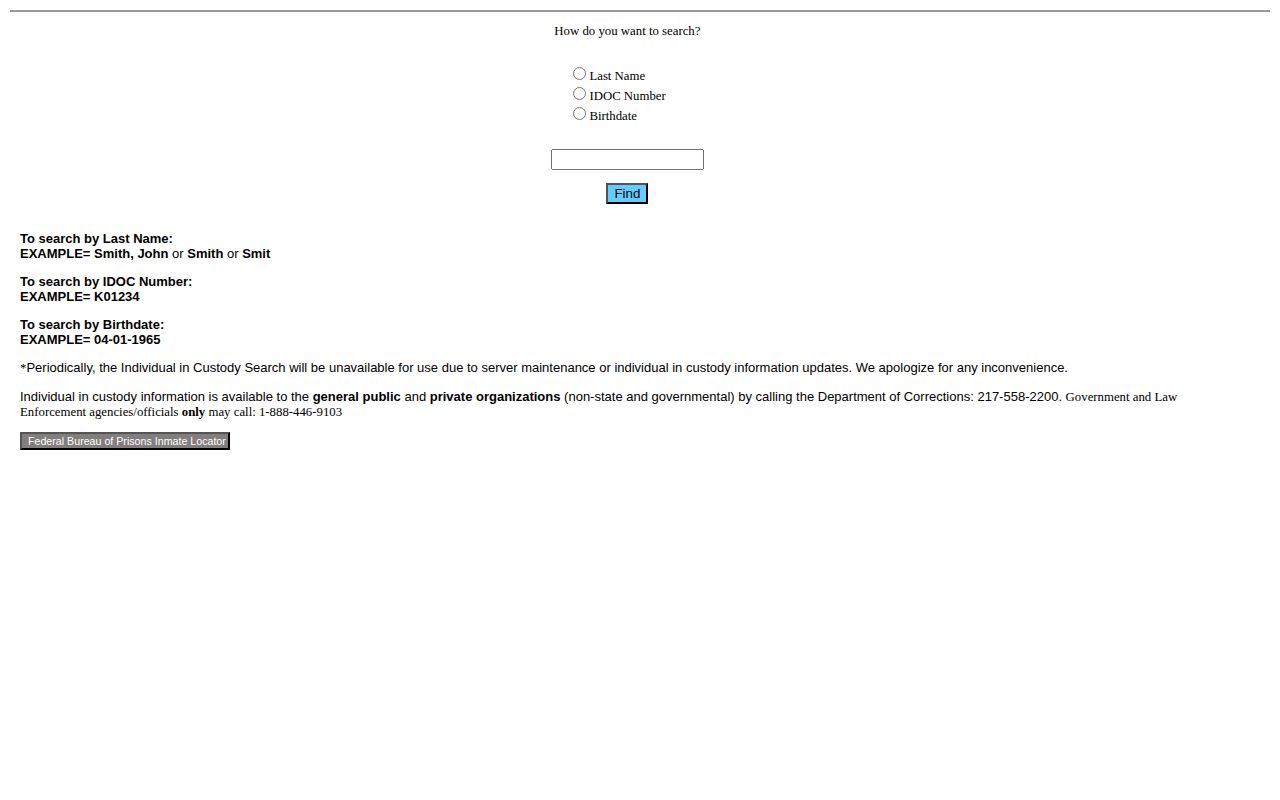
Its name, birth-date, and IDOC-number routes help separate similar names before any date is recorded.
Crawford Sentence Credit Rules
IDOC Directive 01.07.400 says felony calculations use a 30-day month basis. Available jail and custody credits contribute to the custody date, determinate terms receive credit allowed by law, and consecutive terms are aggregated. Release staff check the calculation and set the later discharge date based on the MSR or parole term.
730 ILCS 5/3-6-3 controls state sentence credit and truth-in-sentencing restrictions. The common “85 percent” phrase fits only covered serious offenses limited to 4.5 days of credit per month. Other provisions may require 75 percent or 100 percent. Offense lists, offense dates, sentence terms, and exclusions control. Discretionary Earned Sentence Credit is not an entitlement and cannot be predicted for one person.
County jail credit follows the sentence, documented custody credit, and Illinois county-jail law. The custodian must apply the County Jail Good Behavior Allowance Act to the actual eligibility facts. A universal half-time calculation is unsafe.
Why Crawford Release Dates Change
A date changes when an input changes. Some changes shorten the calculation, while others extend it or replace the sentence record entirely. A detainer is a request or authority from another agency to hold or receive the person. It may change the destination even when it does not alter the end of the current sentence.
| Change | Possible effect | Best proof |
|---|---|---|
| Credit awarded, revoked, or restored | Moves projected date | IDOC calculation and status |
| Corrected jail credit | Changes custody date | Court order and agency calculation |
| Amended or vacated sentence | Replaces prior terms | Signed court order |
| Consecutive cases | Aggregates terms | Judgments and IDOC calculation |
| Escape or lost time | May move mandatory date | IDOC time computation |
| MSR violation or recommitment | Changes custody and supervision path | IDOC and PRB records |
| Other-agency hold | May change destination | Release record and receiving agency |
Confirm Crawford Actual Release
For county custody, the strongest proof combines the sheriff's release timestamp, reason or authority, and destination. A transfer to IDOC, another county, USMS, or ICE ends the Crawford jail episode but is not release into the community. The county archive can be searched by a named person and release range, though it publishes no update cadence or retention promise.
For state custody, read the final IDOC status and actual release information, then determine whether MSR continues. If the live result disappears after complete discharge, request archived public information from IDOC. Ask for admission, actual institutional release, parole or MSR, discharge, and sentencing fields.
VINELink can send event alerts from a participating custody source. It is not the source of the sentence calculation and cannot promise advance notice. A court docket can explain the legal authority, while the custodian's record proves processing.
Illinois Has Two Release Dates
The official IDOC sentence-calculation directive separates projected release from mandatory release. Statutory credit revocation or restoration affects the projected date, while lost time can move the mandatory date. That distinction is the Crawford County projected release date angle most likely to be lost in a quick percentage estimate.
Record the exact label and the date on which it was checked. Then repeat the check near the expected event. A one-time screenshot is evidence of what IDOC displayed then, not proof of a later departure.
Crawford Date Search No-Result
An IDOC no-result does not establish release. IDOC states that a person may be discharged, held in county jail, in another state, or indexed under another name. Try the IDOC number and birth date, then check the county roster, archive, and court docket. If the sentence is complete, use the IDOC archive route.
A county roster no-result also has limits because that roster covers current custody. Search the archive or request the booking-and-release record. The correct fallback follows the last proven custodian rather than treating absence as the conclusion.
Crawford Court Date Evidence
The public criminal docket explains why custody exists and whether a sentence changed. Ask the Crawford County Circuit Clerk for the judgment, sentence, custody-credit order, mittimus, amended orders, and later satisfaction or discharge entry. A mittimus is the written authority that commits a person to custody. It can show a move to IDOC rather than community release.
Unsealed Crawford records may be viewed at the courthouse, and copies are available for a small fee. The office is on the second floor at 100 South Douglas Street, Robinson, with weekday hours from 8:00 a.m. to 4:00 p.m. The telephone is (618) 544-3512. Staff can provide public records but cannot calculate a sentence or give legal advice.
Compare the court record with the custodian's date. The order supplies the legal inputs. IDOC or the jail applies the calculation, tracks credit changes, and processes release. If the two appear inconsistent, ask the custodian to identify the order and credit used rather than attempting to repair the math from a short docket entry.
Read Crawford IDOC Date Labels
A live profile can contain more than one projected date. “Projected Parole Date” may apply to a parole framework, while “Projected MSR Date” anticipates release to mandatory supervision. “Projected Discharge Date” anticipates the later end of sentence and supervision. Copying only the first date can misstate the event. Record the label, value, status, and date of access together.
IDOC's live search covers people incarcerated or on parole. After a sentence is complete, the profile may no longer appear. For an archive request, email DOC.FOIARequest@illinois.gov, fax (217) 558-5612, or mail the FOIA Officer at IDOC, 1301 Concordia Court, P.O. Box 19277, Springfield, IL 62794-9277. Include full name, birth date, IDOC number if known, and received year.
Ask for public fields that distinguish admission, actual institutional release, parole or MSR, and final discharge. The official calculation, not outside arithmetic, accounts for credit decisions, aggregated terms, and lost time.
Crawford Transfers Are Not Release
A county release timestamp can mark transfer to another custodian. If the destination names IDOC, search the state profile and do not call the county timestamp community release. A federal hold leads to the federal docket and USMS path. An immigration transfer leads to ICE records. Another county requires that receiving jail's records.
The same rule applies at Robinson Correctional Center. A VINE event for transfer or out-to-court means the person left that location for another custody event, not that the sentence ended. IDOC directs users to VINE for five event types, so read the exact notification wording.
A detainer may change where someone goes even when the projected end of the current sentence stays the same. Confirm the current term with its custodian, then follow the documented receiving agency.
Crawford Release Timing Limits
No official local source states an average release hour, weekend processing rule, pickup place, or guaranteed time between a court order and the jail door. A date should not become an appointment time. Immediate logistics questions belong with the Crawford County Jail at (618) 546-1515.
The county archive publishes no update cadence. A new event may not appear at once. Save the search time and request the named record when proof matters. The archive form's 15-day query limit is not a claim that records last only 15 days.
Crawford County Versus IDOC Dates
A county jail sentence and an IDOC sentence require different calculations. For the county jail, obtain the Crawford judgment, all custody-credit orders, and the jail's current computation. The County Jail Good Behavior Allowance Act may apply only as the custodian interprets it for the person's sentence and eligibility. A roster bond field is not a release-date calculator and may not reflect later court action.
For IDOC, use the state profile and exact projected label. Consecutive terms are aggregated, available jail credit contributes to the custody date, and release staff confirm the computation. The later discharge date also accounts for the applicable MSR or parole term. That work cannot be reproduced safely from sentence length alone.
When the holding agency is unclear, check the most recent official record. The Crawford County Jail is at 203 South Jefferson Street and Robinson Correctional Center is an IDOC facility northeast of the city. Similar location names can send a search to the wrong system. A county arrest need not lead to Robinson Correctional Center, and a Robinson prisoner need not have a Crawford case.
Record each event in order: court sentence, county custody, transfer if any, IDOC admission, projected MSR or parole date, actual prison release, supervision, and final discharge. This timeline makes clear which date is a calculation and which is a completed agency event.
Public Record Search
Sponsored Results