
Crawford Parole Versus Probation
Illinois uses mandatory supervised release, often shortened to MSR, for many people leaving prison after a determinate sentence. IDOC Parole supervises that period in the community. Traditional parole still matters in older indeterminate cases and in certain proceedings authorized by law. Crawford County probation is different. A judge orders it in a criminal case, and the First Probation Division of the Second Judicial Circuit supervises it locally.
A person may serve time at the Crawford County Jail and then begin probation without ever entering IDOC custody. Someone leaving Robinson Correctional Center may begin MSR even if the underlying case arose elsewhere. The agency that held the person therefore controls the first record search.
| Record | Who orders it | Where to verify |
|---|---|---|
| MSR or state parole | Illinois law, IDOC, and PRB process | IDOC profile, archive, and supervising parole office |
| County probation | Sentencing judge | Circuit Clerk docket, probation order, and local probation office |
| Final discharge | Agency or court with legal authority | IDOC discharge record or court termination entry |
- Parole
- Conditional community supervision tied to a prison sentence.
- Probation
- A court sentence supervised in the community, sometimes after jail.
- MSR
- Mandatory supervised release, the Illinois supervision term that commonly follows a determinate prison sentence.
- Discharge
- The legal end of the sentence or supervision, not merely release from a building.
Verify Crawford Post-Release Supervision
Start with identifiers, not assumptions. A matching IDOC number or court case number is much safer than a name alone. The live IDOC search includes people who are incarcerated or on parole, but a completed sentence may disappear from that public search. County probation is confirmed through the sentence and later docket entries.
- Identify the last custodian. Use the Crawford County Jail path for a county episode and the Robinson Correctional Center path for state custody.
- Search the IDOC offender form by IDOC number, birth date, or name. Read the exact status and projected MSR or discharge label.
- For probation, obtain the public sentence, probation order, revocation entries, and termination entry from the Crawford County Circuit Clerk.
- Contact the named supervising office for a lawful, person-specific question. Do not infer an office solely from a residence.
- If the state profile is gone, request archived public fields from IDOC, including actual release, supervision, and discharge dates.
The Crawford County release-record search path can establish when a county jail episode ended. It does not by itself prove that probation began or that MSR later ended.
Crawford County Probation Office
The official Crawford County probation page identifies the local office within the First Probation Division. Staff may confirm information that is public and appropriate to disclose, but the signed order and docket remain the best proof of the sentence.
Crawford County Probation105 Douglas Street
Robinson, IL 62454
Phone: (618) 544-2575
Fax: (618) 546-5184
Hours: 8:00 a.m. to 4:00 p.m.
State parole questions follow IDOC. Its public line is (217) 558-2200, while IDOC directs parole matters to (800) 666-6744. Constituent Services operates on weekdays from 8:00 a.m. to 4:00 p.m. A county probation officer cannot resolve an IDOC MSR record, and IDOC cannot rewrite a Crawford County probation order.
Crawford Supervision Violations
Conditions are rules attached to release or a court sentence. They can include reporting, travel limits, treatment, or other terms stated in the controlling order. A violation allegation may lead to a hearing, added conditions, revocation, or return to custody. It is not a new conviction merely because an agency lists a person as wanted or as an absconder.
An absconder is a person whom the supervision agency alleges stopped reporting or left supervision without permission. No Crawford County public absconder list was verified. Check the exact IDOC status for state supervision and the court or sheriff for a local warrant. VINELink notifications can report custody events from a participating source, but silence from VINE does not prove that supervision remained unchanged.
PRB revocation schedules and results concern Board proceedings. They do not replace an IDOC status record or prove physical release. A calendar shows planned work; a decision shows Board action; IDOC records show custody and supervision status.
How Crawford Supervision Ends
Release from a jail or prison starts a community phase in many cases. Discharge ends the legal supervision term. For IDOC, distinguish a projected MSR date from a projected discharge date. The first anticipates leaving prison for supervision; the second anticipates the end of the sentence and supervision. Neither projected label proves that the event took place.
For county probation, look for a court entry showing termination, successful completion, discharge, or revocation. A missing jail name proves none of those outcomes. The Circuit Clerk can provide unsealed records and copies for a small fee, though staff cannot give legal advice. For completed IDOC cases, an archive request should ask for public admission, actual institutional release, parole or MSR, and discharge dates.
Early final discharge from state supervision has its own PRB process. Eligibility and final action must come from the official record, not a date estimate.
Crawford Parole Hearing Records
The Illinois Prisoner Review Board publishes monthly, revised hearing schedules. Robinson Correctional Center may appear on a facility calendar, but that does not mean every person there has a parole hearing. Modern determinate sentences commonly lead to MSR without a traditional discretionary parole grant. Older C-number cases and certain youthful-parole matters follow distinct statutes.
Use the PRB operations page for calendars and the Board's current results or historical minutes for decisions. Outcomes can include grant, deny, continue, rescind, or violation action. Then confirm the actual custody event through IDOC. A grant can still be followed by processing, conditions, or another hold.
Robinson Reentry Before Parole
The official Robinson Correctional Center program list names Transitions, Parole School, a Reentry Summit, Life Skills, substance-use programs, parenting, veterans transition, and community work crews. These are preparation channels within a state prison. They are not Crawford County release records and do not prove that a particular person took part.
Program access and current availability must be confirmed with IDOC. The distinction matters: a program may help someone prepare for supervised release, while the IDOC profile and final release record establish whether that release occurred and whether MSR continues.
The official IDOC page shown below identifies Robinson as a state facility and describes its programs. That state source keeps prison reentry separate from county probation.
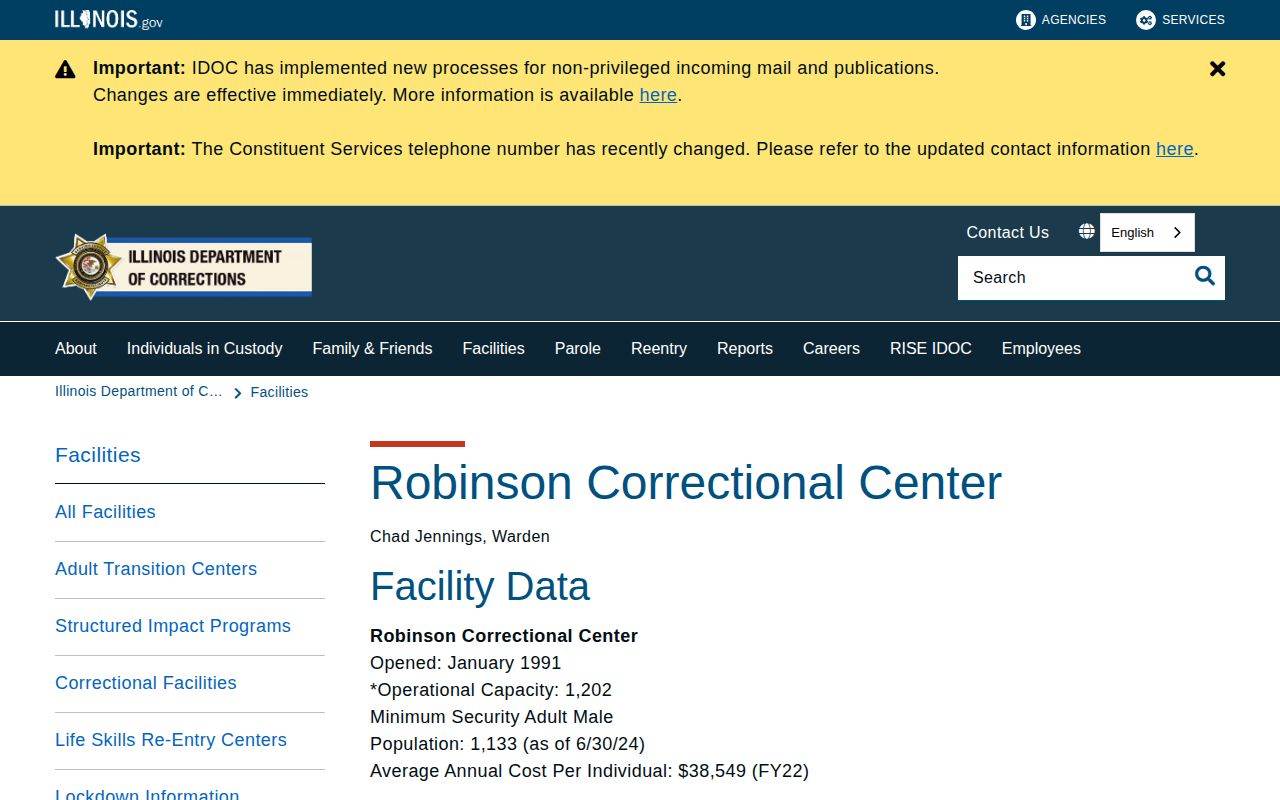
The program list supplies context, while person-specific supervision must still be verified through IDOC or the sentencing court.
Crawford Supervision Record Limits
Each official source answers only part of the supervision question. The sheriff release record can show when the county jail episode ended and whether another agency received the person. It does not set probation terms. The Circuit Clerk docket can show the probation sentence, later revocation, and termination, but it may precede the jail's physical processing. IDOC establishes state custody, parole or MSR status, and discharge. PRB records establish Board action.
A no-result must lead to the next source. An IDOC no-result can mean complete discharge, county custody, another jurisdiction, or a different indexed name. A missing county roster entry can mean release, transfer, spelling error, or update delay. Match a date of birth, IDOC number, booking number, or case number whenever possible. Common names are not enough for a reliable Crawford County supervision finding.
For an archived IDOC record, provide full name, date of birth, IDOC number if known, and received year. Ask only for public admission, release, parole or MSR, discharge, status, and sentencing fields. The agency states that much of the master record remains confidential. A focused request respects that boundary and is more likely to identify the correct record.
Crawford Parole Notification Channels
Illinois VINE and PRB Victim and Witness Services are separate systems. IDOC identifies VINE as a way for victims and concerned citizens to receive notice of release, transfer, escape, death, and out-to-court events through available phone, email, text, or app methods. The alert reports a custody event from its supplying agency. It does not prove probation status or final discharge.
PRB Victim and Witness Services concerns Board hearings and actions. Its public contacts are (217) 782-7273, (800) 801-9110, and prb.victimservices@illinois.gov. Registering with one service does not enroll a user in the other. Someone following both state custody and a Board proceeding may need both channels, plus direct IDOC confirmation after action.
County probation has no equivalent public event feed in the research. Use the sentencing docket and local office. If a probation case is revoked and a new custody episode begins, the court entry explains the authority and the sheriff or IDOC record shows the custodian.
Match Crawford Supervision Identities
Name-only searches can mix records. For IDOC, compare the IDOC number, birth date, middle name, admission date, and holding offense. For probation, use the Crawford case number, full caption, sentence date, and signed order. If a court file refers to an IDOC commitment, carry that case number into the state-record request.
Exact status words matter. “On parole” in an IDOC result indicates state supervision, while a projected MSR date is a future calculation. A probation order proves a sentence, but a later entry may show revocation, modification, or discharge. A warrant or wanted label is an allegation of noncompliance, not proof of a new offense.
When a transfer crosses systems, search both sides. A Crawford County Jail release field naming IDOC proves that county custody ended and identifies the next likely custodian. It does not prove community release. The receiving IDOC record then controls state custody and later supervision.
Public Record Search
Sponsored Results